Brrr


Today I went to the Lowell Folk Festival. At many of the performances, people got up to dance. A lot of little kids did the jumping-around thing that kids do, which was fun to watch. But in front at the stage with the Irish band, there were three girls who had something special.

None of them looked trained, but they were exceptionally graceful. They had that freedom of movement that comes when you have an impression of what trained dancers look like, but you've never had actual steps drilled into you.
My first instinct was to go over to their parents and say, "They've got talent! Maybe they'll want to study Irish dance or ballet!"

But part of me quailed at the idea of formalizing their leaps and twirls. I thought of long hours at the studio, auditions, stage fright, eating disorders, bleeding feet.
I watched, in love with their beauty. They were so free, so confident in their own bodies. Their grace was uninhibited by any fear of looking foolish. How can we, as adults, recapture that?

I got up and joined them. Some other women with bad tans and obvious Irish dance training appeared. Soon there were lots of us, skidding on the dance floor that was slippery from rain. We sprang and twirled, slipping, laughing, falling down.

As the band was packing up, I approached two of the girls. "I had so much fun watching you dance," I told them. "Keep having fun."

This is part 2 of a series on things that are going well in my life. Maybe you'll read it and think, yikes, that would never work for me. But maybe it will give you a jumping-off point.
I'm a member of a women's folk dance team, Muddy River Morris. We do traditional dances from the Cotswold region of England, as well as a lot of dances we made up in that style.

I love the pattern Morris it gives to the year: October is time for the apple orchard tour. April is New England Folk Festival time. May Day is for dancing at dawn by the banks of the Charles, and later in the month there's the Marlboro Ale in Vermont, a weekend of dancing throughout the countryside all day and drinking and singing all night. After each of these, there's usually a feast. The week is also patterned: Tuesday is Muddy practice night, followed by a trip to the bar.
We have women from their late teens through their early 60s (though mostly bi-generational, with a lot of 20-somethings and 50-somethings.) We have married, single, widowed, and divorced women. We have sets of mothers and daughters, ex-girlfriends, sisters, and sisters-in-law. We've seen each other through dissertations, deaths, births, adoptions, and the occasional goth stage.

I don't like the ways sports and political identities get antagonistic. Group identity can easily become us vs. them, which is not something I enjoy. With Muddy River, there's a solid feeling of us, and we don't really need a them. People wear purple shirts to practice because it's our team color. They get really excited to choose the theme for the team skit at Marlboro (last year: gnomes). There are Muddy River cocktail parties and potlucks. We show up to each other's concerts, plays, and weddings.
I love having a women's space. I think women feel freer to argue, drink, yell, belch, and talk in a women's space. I love that the older women started in an age when Morris was for men, and they've carried us through into a time when women's teams are normal. (Inasmuch as Morris is ever "normal.")
I like being in a community that's been chugging along since 1975. I like looking around and expecting to still be dancing with some of these women in another few decades.

I was watching Fiddler on the Roof this week, and something unusual struck me about it. Like most musicals, its characters have the habit of bursting into song whenever an emotion passes over them. These spontaneous songs are accompanied by an invisible orchestra.
But what's different are the dance numbers. There are only three: One with men drinking in a tavern, one with a city boy introducing a country girl to the idea of couple dancing, and one with a whole community celebrating a wedding. Yes, the dancing is more polished than you would expect from life outside musical theater. But at the core, these are dances people really were doing in rural turn-of-the-century Russia.

In most musicals, the dance numbers come from out of the blue like the songs and orchestras. If the dancing happens for a reason it's in movies about dancers like Saturday Night Fever or Dirty Dancing. The numbers are still choreographed, professional.
But dancing used to be a normal social activity. Jane Austen indicates that the only people who "don't dance" are the physically infirm or hopelessly snobbish. She writes about other social activities (picnics, visits, parties), but dancing was obviously her top pick. That's what's lovely about the celebration scenes in Fiddler: These are normal people in a community setting. Dancing.
When Jeff and I got engaged, our friends threw us a surprise contra dance party. There were people there who had never seen anything like it. “I didn't know people still did stuff like this!” one friend gushed. “People are in a room together, looking at each other's faces and smiling!”
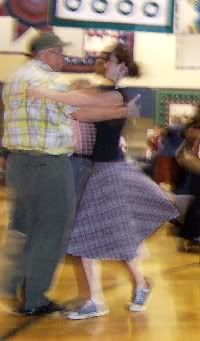
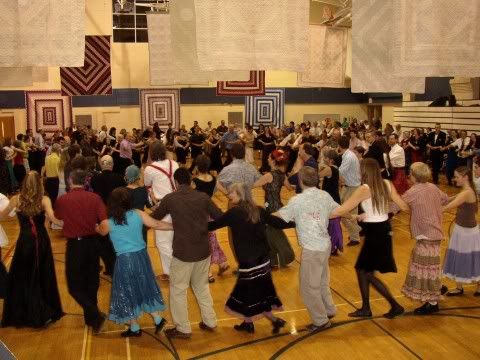
If you've never tried community dancing, dancing where the point participation rather than performance, do yourself a favor. Find someplace to give it a try. My personal favorite is contra dance. Depending on where you are, you might be able to find western-style line dancing in a bar, English country dancing, a ceilidh, or “international” folk dancing (European and Middle Eastern circle dances). There are also social dances like ballroom and swing, but these take longer to learn and are couple-oriented rather than group-oriented.
Go on, give it a whirl!
When I was a teenager, my family went to a folk dance week once a year. The young people there danced harder, stayed up later, and were generally way cooler than me. I desperately wanted to be a hotshot like them. Unfortunately, I was stuck in a town without much of that. I was the only young Morris dancer within seventy miles. Our contra dances were infrequent and slow-paced. It was frustrating.
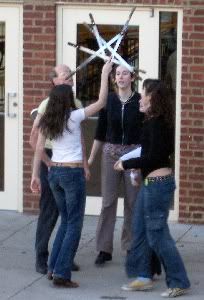
When I was sixteen, I had an email exchange with a young dancer in the Boston area. She complained about how the youth rapper sword team she danced with wasn't really her favorite, and she would prefer to be on one of the other youth rapper teams. My jaw dropped. There wasn't a sword team in my entire state, let alone one with anyone under 30, and she was complaining? I vowed to move north as soon as I could.
At age twenty-two, my dreams were coming true. Everyone wanted to dance with me, I was engaged to a hot young folk dancer and musician from Boston, and we were working on the crew that summer at Pinewoods dance camp, folk mecca of the United States. Of course, I was also terrified because the other workers at Pinewoods were people who had grown up doing all this. These were kids who had been hot dancers for a lot longer than I had.
The crew worked all day together, and at night we danced. We formed a crew rapper team, and I was sure I wouldn't be good enough. My boss, the one I wanted most to impress, was the best rapper dancer of us. I was sure she would lead the set. Instead, she asked me to take the leading position.
I couldn't understand. She knew the most, by far - why wouldn't she want to take the lead? Eventually, I figured it out. She had passed through her hotshot stage. She knew she was a better dancer than the rest of us, and wasn't interested in showing off. She was moving on to the teaching stage.
Last summer, Jeff and I went to a contra dance together. It was pretty tame, as Boston dances go - not many dancers, not many young people. Jeff was calling, so I couldn't even dance with him. But there were a few beginners there, and I made it my mission to be sure they had a good time. In the process, I had a good time too. If I had only been at the dance for my own enjoyment or to show off, it would have been miserable.
There are dancers who stay obsessed with The Best forever. They don't want to dance with beginners. They want to dance the fastest and coolest they can, all the time. But the more mature ones move on, and start bringing out the best in others.
I just returned from a week at folk dance camp. The surprise pleasure of the week was how intergenerational it was.
Americans may work, but rarely play in mixed-age groups. The folk world is a welcome change in that regard. Most of the best Scottish and all of the best English dancers I know are over age 40. (By "best", I'm judging not only for grace and skill but also enthusiasm and enjoyment.) Physical vigor is useful, but knowledge and spirit are more important, so people can continue to develop as dancers for decades. If your knees or ankles go completely, you can take up an instrument or sit on the sidelines and gossip. I like knowing I can continue in this community until I'm old, and that friendships with other dancers formed may well last the rest of our lives.
Our culture holds up young women, maybe 15 to 25, as the most beautiful. But the teenagers I saw at camp looked undeveloped compared to people their parents' and grandparents' age. The girls, still with children's streamlined torsos, looked unformed in their formal dresses shaped for older bodies.
I was there as a kind of understudy to the session's main organizer, a doyenne of the folk world who's in her fifties. With her upswept gray hair, sheer stole, peacock-blue gown, and orthopedic sneakers, I thought she was the most elegant woman at the ball.


"Open air wedding dance", Pieter Bruegel the Younger. Don't they look like they're having fun?
Three more days.
There's something very comforting about coming back to things you did as a child, especially if you get to bring a new person with you. I spent my childhood weekends tagging along with my parents at Morris ales in a miniature version of their kit, then my teenage years dancing myself. At one point my immediate family composed about half the team. 
I went to college in Philadelphia, a town with a regrettable lack of Morris teams that let women dance. Every year at Bryn Mawr's May Day celebration, the local men's team would perform. Their kids would wander around, wearing tiny bells on their ankles just like I used to do. Someday, I hoped, I could dance again? And have Morris babies with little bells on their ankles?
Months before I graduated, some lovely people decided to pull a team together for May Day. Oh the joy! The bells! The handkerchiefs!
Today twelve of us are on our way to the New England folk festival for two and a half days of music and dance. At the helm of the trip is Jeff, the boy I get to keep forever (and the other parent of any future Morris babies). He's untrained but certainly one of the more enthusiastic members of the team. There's something very right about doing Morris with him.
Yesterday I was pinning together my old hair ribbons for his vest, feeling a bit medieval. There's a wonderful passage in The Return of the Native about the lamentable effect of female improvements upon folk tradition, in this case mummers' plays:
The piece was the well-known play of Saint George, and all who were behind the scenes assisted in the preparations, including the women of each household. Without the co-operation of sisters and sweethearts the dresses were likely to be a failure; but on the other hand, this class of assistance was not without its drawbacks. The girls could never be brought to respect tradition in designing and decorating the armour; they insisted on attaching loops and bows of silk and velvet in any situation pleasing to their taste. . . .
It might be that Joe, who fought on the side of Christendom, had a sweetheart, and that Jim, who fought on the side of the Moslem, had one likewise. During the making of the costumes it would come to the knowledge of Joe's sweetheart that Jim's was putting brilliant silk scallops at the bottom of her lover's surcoat, in addition to the ribbons of the visor, the bars of which, being invariably formed of coloured strips about half an inch wide hanging before the face, were mostly of that material. Joe's sweetheart straight-way placed brilliant silk on the scallops of the hem in question, and, going a little further, added ribbon tufts to the shoulder pieces. Jim's, not to be outdone, would affix bows and rosettes everywhere. . . .
The guisers themselves, though inwardly regretting this confusion of persons, could not afford to offend those by whose assistance they so largely profited, and the innovations were allowed to stand.
Luckily Morris is supposed to look silly, so I can do no harm here.
People who teach nineteenth-century literature love to talk about homosocial spaces. Men had the military, the courts, the government, the businesses, the clubs, the bars, the Masons, most schools, you name it. Women basically had the home and eventually the beauty parlor.
Except now . . . there's Bryn Mawr. On Monday I was reminded this of how totally beautiful that can be and how old it can get. Part of the week before graduation is apparently the seniors and a bunch of professors going on a riverboat cruise, which ended with people dancing. If gyration-type dance is going to happen, I definitely like it better with all women. I've heard there are sketchy women, but I've never met any who hold a candle to your average sketchy man.
I looked out at the crowd of writhing women in little black dresses thought: we finally get our own. This is what Virginia Woolf wanted for women instead of getting chased off the grass at Oxbridge. We're eating sashimi instead of prunes and custard. And not only that, but there are hardly any male spaces left.
Then two of the professors (one male, one female) started ballroom dancing. And I would have swapped nearly everyone on that boat for a man with a decent lead. I guess I can't have things both ways.
The problem with contra dances is that afterwards, I'm still too excited to sleep very much. Eight hours is a long time to not be awake and excited, particularly this week.
Above the little house the cold stars shine, and from the open door comes the sound of fiddles. It's around three in the morning and the crowd has thinned down to about a hundred people, standing in the kitchen or perched on the arm of a sofa or dancing across the creaking floorboards. Some college student from Oregon is working magic with the piano, and five or six fiddlers are pouring out jigs and reels with the aid of a flute and a double bass. All week we've been dancing in spacious gyms and classrooms, but this is folkdance in its native habitat. It feels perfect.
You try to avoid major collisions, but it's so close and bumping into people so inevitable that you feel part of a single organism. We've given up on formalities like ballroom hold and asking people if they would like to dance - we just take a handy person around the waist for a waltz or a mad approximation of the Levi Jackson Rag, holding each other close out of dizziness or affection. There's not enough room for distance, anyway. I scuff through a polka with my head on Daniel's shoulder and keep banging my teeth every time we get jostled because I can't stop smiling.
In a few days we'll be scattered from this town in Kentucky. We all have other lives and know we can base nothing on this one week of the year. But as we drive or fly or walk home, tired-eyed, we will all dream of each other and of this house. Jim's smile, Will's perfect blue-green eyes, Wendy's laugh, a hand on your knee, the wild high notes of a violin, the curl of Michael's hair, a kiss after a botched jig, Alice's sweet alto singing "Goodnight Irene" - we'll remember these things and smile.
"You know - on some level, we live all year for this night," says the man I'm dancing with. He's right, whether we all know it or not. I do know it.
One of the advantages to growing up is that when you watch The Nutcracker with your mother, you can both comment on how attractive Mikhail Baryshnikov is without either of you feeling weird that the other has noticed.
To the women of Haverford College:
When a college hosts a swing dance, three types of people will come - a very few hotshot college kids who know what they're doing, the rest of you who don't, and some old men. And so, my dears, you have options. You can sit on a chair next to your boyfriend, and you can shuffle back and forth with some kid who learned how in the workshop 35 minutes ago. Now let's look at the strange men on the sidelines - why are they there? Well, that one with the combover in the blue shirt chewing gum of exactly the same color blue taught the workshop, so you know he knows what he's doing. The others showed up because they've been swing dancing for decades and they love it. Grab one.
Granted, when you dance with them you're leaving the poor clueless boys alone, but since no competent older women have come they're kind of lost either way. If you only dance with other beginners neither of you is going to improve, so you might as well learn with the old guys and then impart your knowledge to that boy from your econ class.
You'll find that, unlike in other pursuits, a dance partner doesn't have to be remotely compatible with you. That fellow whose chest and belly slope out so the dandruff from his beard collects on the front of his shirt may be the least attractive specimin you've ever seen, but the fact that he weighs 270 means he can dip you almost effortlessly because he's just got so much counterweight. You just might have the sexiest slowdance of your life with that man in the bad 80s glasses, because unlike your prom date he actually knows what he's doing. You can make eyes at that greybeard while he spins you and, unlike the guy from your econ class, he will only laugh and won't ever see or pester you again. And you will both have a great time. Go for it.
Last night I went to a student dance concert - modern dance, which I've never been much good at deciphering. In trying to figure out what the dancers were supposed to symbolize I was looking at the colors of their costumes, the way they were grouped on the floor, etc. I didn't even consider their gender until I started wondering what non-Bryn Mawr students were making of it and realized that to them the dancers represented four women, and at most other schools they would have represented four women. To me they represented four people.
In a community where a given variable - in this case gender - doesn't vary, you start to ignore it in a way you never could otherwise. You speak in class without feeling that you're representing your group to outsiders, because everyone around you is part of the group. You never walk into a room or sit down at a lunch table where you're the only one of your kind. (Granted, I'm speaking purely for gender, and if I were of a different race or varied from society's defaults in some other way none of this would be true at Bryn Mawr.) We can pretend to be blind to gender or race or any other variable, but that's masking that on some level inequalities and problems exist. Nobody tells jokes about a woman who walks into a bar unless the joke hinges on the fact that she's a woman. It's always a guy walking into a bar. Men are the default, and anyone else is an exception. I don't know if four years of thinking of yourself as a human instead of a woman (or a black at an HBCU, or any other parallel) can give you a lasting power to think that way, but it sure feels good while it lasts.
Last night I went to the culture show put on by the African and Carribbean students' group. There was a little girl sitting next to her grandfather in front of me, so as I watched the skits and dances I kept wondering what she was making of it. My first reaction was that the shakings of African dance weren't something I would choose for a child to watch, but as the night went on I realized what a weird Puritanical standard I was holding up to the situation.
Given that this girl probably sees Shakira on TV doing far worse, I was glad she was in this room. Given what else is out there that she could be hearing, I'd much rather her be hearing Maya Angelou's “Phenomenal Woman.” Given the reality of violence in our world, I'd rather her hear a condemnation of domestic abuse and violent African political regimes than be at home playing Tomb Raider or watching Kill Bill (or for that matter, ignoring the violence entirely and thus doing nothing to change it). During the fashion show at the end, as we watched each smiling woman in costume from Ghana or Haiti or Cape Verde sway and shimmy up the aisle to “African Queen”, I was so glad that she was watching them instead of the identical, shiny-haired contestants from Miss America or any other pageant.
Why is it that we consider certain aspects of adulthood appropriate for children to see and others not? A dance that shows off the shape of the adult female body is considered inappropriate because it's considered sexual. But when I saw my classmates on that stage and saw how much the little girl loved seeing them perform, I saw a celebration of themselves, their bonds to each other, and their national cultures. Here was a presentation of adulthood that was positive for once, something for her to aspire to. Long live Africa.
Despite Sarah's assertion last night that everyone likes to look at women and no one likes to look at men, I've decided there's nothing more fun to watch than college-age guys dancing with each other (unless it's two kittens playing with each other.) There are occasional forms of folkdance that can be breathtakingly lovely done by women, but there's nothing to equal the energy and springiness a couple of 21-year-old college boys can put into a contra dance or a Morris set. If I could jump like that, I would die happy. Hopefully I'll die happy anyway, but until then I'll watch them whenever I can.
I had forgotten until I got off the plane how much I love England. Is there a word for this kind of love of a place? It's the same feeling I have for Denmark - last night when I saw a Danish artichoke lamp in a window I felt the same kind of sudden lift you get when you're in love and you see some reminder of whoever it is. Can you call it nationalism when it's not your own nation?
It feels like coming home in a way that I can't attribute to having been here before. Part of it is the folk tradition, the feeling of finally whistling tunes in their native habitat. Another part has to be the literature - in Paris one can hardly help imagining the characters of Victor Hugo and Gaston Leroux and so on as one passes their various locations, but in London it's so much stronger because a disproportionate amount of my reading material has come from this little patch of earth. When I walk down the streets I feel they're peopled with everyone from John Donne to Eleanor Dashwood to Bertie Wooster to Bridget Jones. Since I was little I've been conditioned by C.S. Lewis and Roald Dahl respectively to believe that Turkish delight and steak and kidney pie were the two best foods in the world.
The folk pilgrimage is proceeding nicely. Last night I went to a Morris practice and then a folk club (people sitting around drinking and singing.) The guy teaching Morris addressed me as "good lass," and the very cute bespectacled Polish bartender tried to give me more shandies for free after my first half pint but failed and had to ply me with lemonade instead.
Also contributing to my happiness is the fact that I'm undivided for once. There's nothing else I need to be doing, nowhere else I would rather be. After so long of feeling pulled towards Boston or Richmond or Bryn Mawr or wherever I wasn't, I feel completely present here.
We have a fall break for the next three weeks, and since the cheapest way to get from one city to another is to fly through London, I'm stopping there on the way back for something of a folk dance and music pilgrimmage. The Cecil Sharp House is the hub of the anglophonic folk world, so I hoped to catch a dance there like Mom did when she went, maybe visit some folk clubs. As for who to see, I thought, who do I know in London? Morris dancers, of course. I don't actually know any, but I sent off an email to the local teams asking if they were performing during the first week of November. I was a bit nervous about this, since in England Morris is done much more traditionally than in the US - meaning that there are those who would rather not see women doing dances traditionally done by men. I understand their point of view, and I admit that I hate seeing women do the Abbots Bromley horn dance, but I think it's a bit extreme. In the 1970s when my mother visited London she wasn't even allowed to watch a men's team practice, let alone dance in with them.
This morning I got an email inviting me to a dance in at a practice of an (all-male) Morris side in the Cecil Sharp House. I feel like Virginia Woolf being allowed to walk on the grass.
Sometimes I feel that no matter what bizarre situations life may throw at me, years of contra, swing and ballroom dancing will have prepared me. For some reason, men (especially old men) at dances consider it their godgiven right to make overtures at any female they please. Of all the strange men who gravitate towards the dance scene, over the past weeks I've met the strangest yet: Howard. His shirts are so thin you can see the liver spots on his chest through the cloth. He has absolutely the worst sense of rhythm I have ever encountered, which makes it impossible at times to even tell which dance he's trying to do. Among his charming lines to me have been: "You can eat later. You're getting fat, anyway," "Can I squeeze your hand?" "I'm drunk," and "You're my favorite babe." I'm almost certain he meant "You're my favorite, babe," but he didn't pronounce the comma.
I consider it the right thing to do to be nice to strange old men and generally clueless people at dances, provided they're not being creepy. Whitehaired men with kneebraces and the like are often there because they've been doing it forever and really love dancing, and it's nice to see some of the clueless ones develop into good dancers. The problem is that once someone has crossed the line into creepiness I find it impossible to say, "Shove off, you weirdo! You're old enough to be my grandfather! And no, you can't squeeze my hand!"
I think I’ve figured out a big part of why that is, at least stereotypically. Revelation came in the form of two three-year-old girls telling me excitedly that their dance recital was that evening and that their mommies were going to come watch them. I have no idea what kind of dance one teaches three-year-olds, but the point is that it’s only taught to girls. In the suburbs, small boys are carted to martial arts studios where they wear little white uniforms, and small girls are carted to dance studios where they learn some semblance of ballet and tap but mostly enjoy wearing pink leotards and twirling a lot. Whether or not we actually go to the lessons, we’re trained from birth to believe that girls dance and boys kick things and yell.
Fast forward twenty years or so to a college party. A crowd of girls is in the middle of the room dancing, some awkwardly, some not. A ring of guys is sitting or standing around, just watching. It's creepy even when the guys don't mean it that way.
Now fast forward another twenty years. A ballroom studio is packed with women, but men are in short supply. The man leading the class is a svelte Latino who wiggles better than the women. I would read his dress and mannerisms as gay if I didn’t know they were the height of masculinity in some countries. If only the white middle-class US concept of masculinity had more room in it for hip-wiggling.
 juliawise07(at)gmail.com
